Sunday, June 29, 2014

“B” is for BONAIRE

2014-06-16 12.36.22
Sample of Bonaire's art: this was on a particle board fence surrounding a construction site. 

Bonaire is the “B” of the ABC Islands- AKA, the Netherland Antilles- that lie 40 to 50 miles north of Venezuela’s northern coast. Many, many years ago, a friend in Indianapolis raved about the endless natural beauty in the reefs that surround the island of Bonaire. When he said the island was an unspoiled diver’s paradise we were heartily intrigued. Then last year, our friends on Tiger Lilly cruised there, loved it, and encouraged us to sail to Bonaire.  How could we not go?

DSCN1800
Can't identify this one, but I like the mask.
DSCN1890
French Angelfish
  
The waters surrounding the island comprise the Bonaire National Marine Park.  More than 100 public moorings line the western coast, as well as the coast of Klein Bonaire- its small uninhabited out island. However, vessels can only overnight at those situated just off the main town of Kralendijk- a small town by US metropolitan standards, but during the tourist season can berth two cruise ships and double the population of the island for the day. We snorkeled right off our stern where the reefy bottom dropped into the dark abyss and saw a pair of large French Angelfish, Yellowtail Snappers, Peacock Flounders, hordes of Sargent Majors, and schools of Blue Tangs and Bar Jacks. Bonaire has eighty-seven specified dive sites. Many of the people we met there were divers and they motored their boats around to different sites every few days, while we dinghied to some that were recommended by acquaintances. We were surprised at the size of the fish even in the shallower waters.

DSCN1854
Kralendijk's main drag
DSCN1857
The free water gym at Karel's Bar
  
The official local languages in Bonaire are Dutch and Papiamentu. Papiamentu sounds like a mix of mostly Spanish and Dutch. Lucky for us, many of Bonaire’s residents also speak English and Spanish. We got along fine except under two circumstances.  The first was at the grocery store where everything is in Dutch and second was at Sunday Mass where every word was in Papiamentu.  At the store, I got needed translations from some Dutch cruisers we met, but at Mass all I could sort of decipher was the page number of the hymns so I sang along in the best pseudo-Papiamentu I could muster and prayed for forgiveness!
2014-06-13 10.38.54
I was barred from getting a closer shot of the flamingos.

One day we road the island bus to the town of Rincon in Bonaire’s interior.  The trip was short, passing plenty of desert scrubland. Rincon was the first settlement on the island set in the shallow inland valley hidden from pirates on the sea. Over time, though, Kralendijk became more developed and populated because of its accessibility on the coast.  The bus driver took us beyond Rincon to see where the flamingos live and the iguanas waddle rampant. (They eat iguana on Bonaire and I wanted to try some, but we were never in a restaurant the day it was on their menu.)

2014-06-13 11.23.10
Cadushi Distillery in Rincon brews with CACTUS!
2014-06-13 13.42.05
All homes are brightly painted; my sister Lee would love this one.
 
We liked Bonaire for many reasons. The island’s reefs are rich and inexhaustible, and we plan on returning to see more. The people made us feel right at home and the shop keepers didn’t haggle us to “come in and look” when we walked through Kralendijk’s tiny tourist “malls’'. The businesses welcomed yachties with a good number of daily activity/dinner/drink specials. We met cruisers there from Holland, South Africa, the United Kingdom, and America. When all was said and done, we all laughed in the same language. 
Oh, yes, we’ll go back to Bonaire.
DSCN1783
Red sky at night, sailor's delight

Sunday, June 15, 2014

DR to BONAIRE Crossing

We thought we were fully prepared for our longest crossing of our cruising experience- 435 nautical miles.  That equates to nearly 501 statue miles to landlubbers. This distance is miniscule when compared to passages made by acquaintances who have sailed across the Atlantic or have circumnavigated the globe. Nevertheless, it would be OUR longest crossing to date and I, for one, approached it with a degree of trepidation.

The life raft was lashed to the deck, the jack lines were in place, simple meals were prepared and stowed in the refrigerator, and the intended float plan was filed with our family. The winds from various reports during our travel window were predicted to be easterly at 10-20 knots per hour. We calculated that the trip would take a little more than three full days if we averaged a speed of 6 kph.  We were also cognizant that our estimated travel time could be adversely affected if we did not successfully manage the easterly seas and northerly currents near the ABCs that tend to push vessels off course. No squalls were predicted although we saw intermittent rain clouds, but none fell upon us.  Yet, we donned our heavy weather jackets early on because there was so much sea spray flying as we raced southward through the waves, averaging 7.5+ kph.
DSCN1851
Our rain gear needed a thorough washing afterward.
To improve our angle on the wind, we motored east from Boca Chica-DR for the first 6 hours. By the time we turned south, the wind measured a steady 18 kph, gusting to 22 and he main was immediately reefed to reduce the angle of heel. Our comfort was not improved, so a second reef quickly went into the main, followed by reefing the headsail well beyond its third reef mark.  The motion and heeling was constant and neither of us had much of an appetite, leaving the prepared meals untouched. The boat was rocking so heavily that Dan felt it was too much trouble to make our morning coffee which added to my discomfort. We didn’t even try to troll while underway because it might have been impossible to safely land the fish if one was caught. To make matters worse, I lost my prescription glasses and had to ‘D. Bohle’ an old pair to wear and they kept sliding off one ear. Another problem occurred when a stainless tube on our davits broke due to the repeated swinging of the dinghy.
DSCN1894
FYI: bandage adhesive tape on a ROLL works best
The last night of the trip while I was on watch, Exit Strategy sailed parallel to the island of Bonaire. When Dan relieved me to begin his watch, I was excited to think that I’d be able to see the island when I awoke.  However, at daybreak when I got up, we still couldn’t see Bonaire! By that time we both just wanted to drop anchor and relax. In an hour or so, the haze had lifted and we were close enough to see the flat southern end of the island.
images[3]
The southern end of Bonaire is extremely flat and produces salt.
We’re so glad to be here for this hurricane season and are looking forward to exploring the ABCs.

Friday, May 23, 2014

The Things You Do For L*O*V*E

DSCN1754
First horse he's ridden in about 15 years
Last week, ideal weather was forecast for our journey southward to Curacao where we plan to spend hurricane season 2014.  The day before we were going to leave, new cruiser friends of ours, Mike and Cate of s/v Horizon, pulled into Boca Chica.  We were happy to reconnect with them and my Captain proposed that we stay put longer since we still had plenty of time to go south. I agreed to delay our departure on the condition that we get off the boat and tour more of the island.
DSCN1750   
The Captain doesn’t like to drive in the islands mainly because the locals maneuver their vehicles like maniacs. Never the less, we rented a compact car for a few days and he braved the roads with one hand firmly on the horn, as is customary in the DR. (He loves me.) I was co-pilot with a map in my lap.

DSCN1770
El Salto de Jimenoa
The first day we headed toward the mountainous town of Jarabacoa. The ride there was interesting with small stationary vendor stands along the highway and mobile vendors at every stoplight. Jarabacoa was more touristy that expected and we took in the sites of El Salto de Jimenoa and La Confluencia after having lunch. It rained quite a bit that day, so when we took an alternate route back there was debris on the road from landslides in several places. That route also went through a small town full of greenhouse after greenhouse that produce flowers for the florist industry worldwide.
DSCN1743
After the rain on the mountain highway
   
The next day Cate and Mike joined us to drive up to Samana, a peninsula on the east coast of the DR. I was co-pilot again, but this time I got distracted by the conversations and somehow we missed a turn in the first twenty minutes. That mistake took us into the capital city of Santo Domingo AND its bumper to bumper traffic. The Captain was not happy. (He loves me not.) While stopped in traffic, I asked a uniformed person (police?) if we had missed our turn. He indicated that it was behind us and began to direct the cars behind us to back up so we could back up to exit! But just then the cars in front of us moved forward, so the Captain pressed on.
DSCN1748
The paved road before the rutted dirt road at the dump
Approximately two hours later we had turned around and were near the correct exit.  I didn’t dare miss it again, so we turned at the first sign for San Isidro where the route we needed intersected the highway. (Wrong.)  At this point, with four college educated adults in the car, Mike asked if we wanted to use their cell’s GPS. (Duh.) We all breathed a deep sigh of relief upon hearing the assuring automated voice. Unfortunately, that moment was short-lived and our stress quickly returned when we realized that there were no roads on which to turn given by the GPS prompter. (“Recalculating…”)To make matters worse, many of the roads in that area were dirt and deeply potholed.  At one point, the GPS directed us to turn onto a road that appeared to be a huge garbage dump, “Turn right and proceed for three kilometers.”  The Captain turned left and somehow we finally made our way to the highway that lead to Samana.
DSCN1774
El Limon
Our goal in Samana was to hike to the El Limon Waterfall which was located easily thanks to ample signage in this ultra touristy area.  When we were nearly there, Ramon pulled along side our car in moving traffic to insist that he’d show us the way.  We wanted to walk to the falls, but after an exasperating discussion with Ramon in half English-half Spanish they put us on horses with individual handler-guides and off we went. I’m fine in the saddle, but the Captain, although experienced, was reluctant. (He loves me.)  Mike and Cate were ready and willing for adventure. It was after all, a memorable excursion- one we’ll no doubt laugh about for years- and the falls were a powerful site, but muddy from the recent rains.
DSCN1767
Los Cuatro Amigos

Easting: It Is What It Is

DSCN1698
Weekend at the beach in Punta Cana, DR
We are sailing cruisers.  We prefer to sail whenever we can. We planned to spend hurricane season in Curacao this year and needed to return to a point further east to get a better angle on the wind to head south. Unfortunately, when in Jamaica- the heart of the Greater Antilles- sailing is more often than not impractical when heading back east.

In the remote folds of my gray matter, I believe it was some noted philosopher who first stated, “It is what it is.”  However, I know for a fact, that our lifelong friend Jim gets full credit for this phrase being forever branded on my psyche. Jim has a unique way of delivering it with a sort of Ebonic dialect that evokes laughter from us. Perhaps that is why it has stuck with me. This phrase was our mantra as we plowed our way eastward after a long and lovely cruise to Jamaica’s west coast. We were not laughing though. Easting: It is what it is.
Dec 07 (135)
Our dear friends Jim and his lovely wife, Barb
Like all cruisers, we listen to the marine weather reports daily on our SSB radio and study weather charts online when available. When you are retired, as we are, you can afford to wait for a good opportunity to sail unless you have some sort of deadline, such as getting your vessel out of the hurricane belt before June 1. So you are in Jamaica in mid April and you would like to be in Curacao by June 1. That allows about six weeks to get there. (No problem, mon, plenty time.) But you know part of your family (that includes two of your grandkids) will be in Punta Cana, DR in early May and wouldn’t it be GREAT to be with them on Mother’s Day?  (YES!)  Now you have two weeks to get to a particular destination.
DSCN1566
There is nothing more frustrating to the captain and crew than a brisk wind coming from the wrong direction.  On good days, the wind was ever so slightly blowing from the North-Northeast or Southeast to ease Exit Strategy in the right direction. On other days, we were surprised with no wind at all, so we motored. Sometimes we were seduced into hoisting the sails and thinking we could zigzag our way along the course, but found that we’d have to sail way off course. So we ended up motoring about two-thirds of the time.           It is what it is. 
Vendors offer refreshments on the Rio Grand Rafting Trip.
Raft Trip on the Rio Grand near Portland, Jamaica 
DSCN1623
Vilna and Dou Dou's trois juene filles, Ile a Vache, Haiti 
In retrospect, we made the best of it- stopping a few times along Jamaica’s northern coast and also resting at Ile a Vache, Haiti to visit friends. We arrived in Boca Chica, DR in plenty of time to rent a car and meet part of the family in Punta Cana for the weekend. It was such a treat to spend time with them AND stay in an all-inclusive resort and sleep on real beds!  It is what it is.  AND it was WONDERFUL!
DSCN1691
Shuffle Board with Bobby, Lyla, and Aslan
DSCN1689
Gaming with Joy, Aslan, and Lyla

Saturday, April 19, 2014

Our Grandkids Part 2: Maya & Genna-WEE JAMMIN Cruise

So far this season, Captain Dan and I ventured all the way to Jamaica (mon) on board Exit Strategy. Recently, our daughter Becky’s family flew into Montego Bay to join us. The WEE JAMMIN Cruise itinerary was filled with laughter, fun in the sun, sand, snorkeling, hiking, and mostly motor sailing in the absence of ample wind.   The highlights follow.
DSCN1419
Grandpa cheesing with the girls...
DSCN1408
This burial on the beach in Montego Bay was the only time they let me lay down for a rest.
   

DSCN1443
Both Genna and Maya loved jumping off the boat. (Here we were anchored at Lucea.)
DSCN1468
We hiked up Mayfield Falls one day.
   
DSCN1490
Sitting along side one of the many pools at Mayfield Falls
DSCN1500
Jeff and Becky
       
DSCN1541
The girls and I did tattoos one afternoon.
DSCN1551
The caves at Push Cart Restaurant in West End.
  
DSCN1561
Ar-r-r-r-r!
DSCN1563
Maya got dreads on the beach at Bloody Bay near Negril.
  

Our Grandkids Part 1: Aslan and Lyla

We have been able to sail to St. Croix to spend the holidays with our son Bob’s family since moving on to the boat and it always makes our Christmas very special.  I tried to post this photo essay months ago, but got frustrated when the internet connection failed repeatedly.  Hope this works today…

DSCN1079
We play loads of games on board.  Lyla's favorite is Connect 4.  Aslan's is Checkers.
DSCN1081
Aslan was often in the lead as we hiked the Caledonia Trail up to the waterfall
 in St. Croix's northwest region.
   

DSCN1134
The toothfairy has been working overtime...
DSCN1098
Bob and Joy with children on rocky shore north of Carambola Resort
   

DSCN1109
From the resort, we hiked through the woods and along a rugged shore ...
DSCN1125
...that ended at a huge tidal pool complete with waterfalls.
   

DSCN1150
Lyla found a pirates map along the beach.
DSCN1102
Aslan and Lyla let Babcia and Grandpa rest just long enough for a photo.
      

Wednesday, March 26, 2014

ILE A VACHE, HAITI

DSCN1338
The view from our boat was tranquil.

Thanks to St. Vincent and the Grenadines, we have extensive experience with “boat boys”.  However, the boat boys in the bay at Port Morgan, Ile a Vache were in a class all their own.  Instead of focusing on selling cruisers like us some useless tourist trinkets, these lads were primarily intent on selling their services to clean, polish, guide or do anything else a boater may need.  Before our anchor was lowered, three pirogues were quickly paddling toward Exit Strategy. These small canoes, carved out of mango wood, appear to leak profusely and are usually manned by two, so one person can keep baling.  We motioned for them to back off and allow us time to set the hook and they obliged. Creole is the official language of Haiti, so we were pleasantly surprised to find that many of the children speak English.  In school they either learn English or French as a second language.  In a blink, about a dozen other pirogues made their way out to greet us and each one politely explained their particular service. We were fatigued from our 140 mile trip and sounded like a broken record- “No, merci, nothing today.”  Another half dozen or so skiffs manned by adults greeted us during the next few hours and we booked dinner with two of them. One policeman came to collect a $5 US anchoring fee.  After a quiet meal, we drifted off to a sound sleep in the clear still waters of the bay.
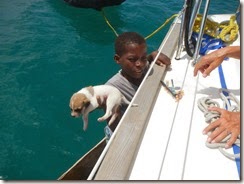
DSCN1341
This boat boy offered to sell us a puppy since we
had no work for him.  Another sang to us in Creole.
DSCN1284
This pirogue was a delux model.
      
At sunrise, sweet birdsong harmonized with passing fishermen singing as they poled their goose-winged sailboats out of the bay. Later that morning, we bought a few hours of internet time using a Hotspot from one of the islands entrepreneurial teens. He gave us a price of $3 US/hr. and we bargained it down to $2.50/hr. (The exchange rate is 43 Gourdes: $1 US, but on Ile a Vache they use the rate of 40 Gourdes: $1 US.) We also made arrangements with another teen for him to go and buy some Haitian beer on the mainland and bring us the change in US dollars.  That afternoon we took a walk around the Port Morgan Hotel and down the dirt road (no pavement on island) into the village.  There were groups of locals and school children milling around various food/drink/snack stands during their lunch break, but no restaurants or stores were in sight.
DSCN1324
DSCN1288
Part of Port Morgan Hotel
   
That evening we dinghied across the bay to have dinner at Jean Jean’s. Our spoken menu choice was chicken or conch, so we ordered one of each the day before.  Mounds of food were served family style to just the two of us.  Six other patrons had dinner there that night and were served in a similar manner.  Our tab for the meal that included drinks was $26 US.
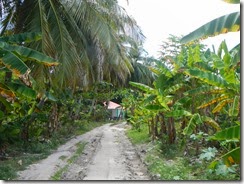
DSCN1291
The main road to the village
DSCN1335
These horses are small, but they pack a lot, including people.
     
There is a market twice a week in the village of Madame Bernard that is a few miles away from Port Morgan.  We had one teen guide us their via our dinghy, as we also wanted to drop off a donation of goods at St. Francois d’ Assises School and Orphanage.  We found the market loosely organized and found what we wanted to buy when our guide Cezar led us through the maze of stalls.  They sold much more than fresh fruit and vegetables there (average cost of a half dozen of anything was 25 Gourdes or about $.60 US). Some vendors had clothing, others had paper goods, and while still others sold drug store items like shampoos, lotions, and over the counter medication. We even saw a steer being hacked up on a large table in the full sun.
DSCN1333
Recess!
DSCN1329
I thought this little guy was sleeping, but he gave me a
huge sweet smile when I touched his arm and spoke to him.
    
Up the hill from the market is where one can find the Centre d’Accueil St. Francois d’Assises.  Sr. Flora, a petit Canadian nun, runs the orphanage that houses 70 children, 25 of which are severely handicapped.  We stopped to leave a donation of goods and to see the children, although we did not meet Sr. Flora because she was in New York seeking charitable contributions. 
 
That evening we had arranged for Dou Dou and his wife Vilna to prepare and bring us a traditional Haitian meal for $10 US per person. Dou Dou and Vilna are soft spoken individuals and handed us a flyer written in English to explain their dinner plan because they don’t know much English.  When they arrived in their pirogue, I took their Dutch oven-sized pot and three plastic containers below to transfer the food into our pots and pans.  While doing so, I saw there was way too much food for just Dan and me.  So I asked them in as much French as I could muster if they would like to eat dinner WITH us.  They looked surprised, but happily accepted.  We had the BEST time visiting with them and I think they enjoyed the multicultural and lingual experience as much as we did.  In fact, they invited us to come and eat at their home the next time we visit the island and we certainly will!
DSCN1347
Notre amis, Dou Dou and Vilna

Prior to visiting Ile a Vache, we had the impression that the islanders were quite poor from what we had read in various publications.  However, after touring part of the island and interacting with some of the people, we found them far less needy than expected. The children and people were clean, smartly dressed, and appeared well-nourished.  Some of the teens had cell phones and IPods.  Yes, the boat boys want to earn money, but they do not beg for food or money.  There are no cars on Ile a Vache, but they do walk, and ride bikes or horses.  Electricity is not widespread because there is no power plant and it is not cabled over from the mainland.  They have access to good water, as we witnessed many youngsters carrying jugs home from the village well, but don’t have running water because it is not piped throughout the island.  We never once smelled sewage as often occurs in other more developed islands. Their land is fertile enough to grow fresh fruit and vegetables and raise livestock.  Circumstances on Ile a Vache allow them to live a simpler life than the average foreigner visitor.  And that is somewhat of a blessing.