Tuesday, January 20, 2015

Cruisin’ with Cruzans

DSCN0254
And we're NOT talkin' RUM, although there was a bit of it on board in the ship's stores.

As many of you know, our son's family is serving at Youth With A Mission (YWAM) at the St. Croix-USVI base.  In January, the Christmas winds finally settled down enough for us to sail Bob’s family up to the BVI for a week.  Aslan and Lyla seemed to prefer “front row seating” near the bow while underway and I was usually sitting between them clutching a strap from both of their vests. While on route there and back, we passed the time (about five hours one-way) identifying shapes in the clouds, singing silly songs at the top of our lungs, watching flying fish skitter across the waves, eating snacks, and looking for dolphins in the surf and mahi mahi under the occasional floating rafts of Sargasso seaweed.

As crew, Joy, Bob, Lyla, and Aslan WORKED HARD-

DSCN2843
En route: Bob and Danny landed a nice mahi mahi for dinner.
DSCN0082
Roadtown, Tortola- BVI: Lyla manned the nav light on the way to shore.
   
On route to Salt I.-BVI:  Joy worked overtime entertaining the kids.


DSCN0456
Norman I.-BVI:  Aslan was the master pizza chef.

 
DSCN0415
Leverick Bay, Virgin Gorda, BVI:  Lyla helped weigh anchor.


…and PLAYED HARDER!


 DSCN0299
The Baths, VG-BVI: They hiked through 3 times!
   

DSCN0221
A well deserved rest after hiking The Baths.


DSCN2914
The Indians-BVI: Aslan dove down to see his scuba diving Dad.


DSCN2915
Wreck of the Rhone, Salt I.-BVI: Lyla descends to her diving Dad.


DSCN2905
Crew enjoyed action packed games of Spoons on many nights.
  Funniest quote came from Lyla  who said,
"Hey, why is there only one spoon left?" 
DSCN0073
The Petroglyph Trail, St. John-USVI

   
DSCN0216
Norman I.-BVI: One last swing on the davit lines.
DSCN2872
Mosquito I. Beach-BVI: Do-It-Yourself crab races
DSCN0350
Devils Beach, VG-BVI:  We had it to ourselves.
    
DSCN0390
The Bath,VG-BVI: And a very good time was had by all! 


Tuesday, December 30, 2014

North By Northeast Passage

DSCN2772
Perhaps this religious grotto on the rugged north coast of
 El Grand Roque blessed our journey as we said "Good Bye."
Seasoned cruisers know that if they are in the vicinity of the ABC Islands or Los Roques Islands and intend to make their way north to Puerto Rico or the Virgin Islands, it is one of those “You-Can't-Get-There-From-Here” easily routes.  Oh, it is possible, but to do so one must traverse the first 60 nautical miles through a strong westerly current and westerly fetching seas and then make your way northward through the remaining 340 or so miles in moderate westerly currents and seas. So the wise crew must work to get as much ‘easting’ in as possible early on in the journey or end up motoring east dead into the wind and waves later.  With this in mind, the good captain set a course for Exit Strategy towards Frederiksted on St. Croix’s western coast and hoped that we’d make land fall no further west than Salinas, Puerto Rico.

A prime weather window for making this passage began on Thanksgiving Day. During the first twenty-four hour period we were blessed with east-southeasterly winds of 12-17 knots and seas of 4’-7’.  Once underway, the Captain was able to adjust our course farther east to take advantage of the winds and get some of that much needed ‘easting’ in early. The main was reefed and the vessel glided effortlessly and quietly through the water. We gratefully enjoyed a Thanksgiving meal of roasted chicken and freshly made potato salad. All was well on board.

DSCN2776
Sailing conditions were perfect under sunny skies and starry nights.
On the second day, the east-southeasterly winds continued, but were reduced to 8-14 knots accompanied by seas of 3’-4’. We gladly shook the reef out of the main and once again, were able to move our course farther east.  This time we aimed for the EAST coast of St. Croix, fully expecting to ultimately be blown toward Frederiksted.  We were ecstatic to have been sailing northward comfortably for two solid days, averaging about 7 nm/hr. And I was so relieved to be able to sleep soundly when not on watch at night.

On the morning of the third day, the wind and seas were even more subdued. We were anxious to arrive in St. Croix before nightfall, so we adjusted the sails and fired up the engine to motor sail the final 60 miles.   By midday, St. Croix was visible at the horizon over a relatively flat sea.  We began to pass huge mats of sargasso seaweed floating on the surface of the water and we knew it was the perfect time to hook some mahi mahi, as they like to rest under any flotsam. Within a short time, we had hooked three mahi mahi! We hauled them aboard with the gaff, cut off each head, and cut them into slabs small enough to stow in the refrigerator to be cleaned hours later when at anchor.

DSCN2780
Sargasso Seaweed
Our crossing from El Grand Roque to Buck Island near St. Croix's northeastern coast was 385 nm long and took us two and a half days. Each morning we listened to the SSB radio Weather Net at 7am and then checked into the 8am Coconut Telegraph Net.  We had heard that friends of ours set sail for the USVI a day before we did and arrived a day afterward.  The main difference was that they left from Bonaire and we left from Los Roques, putting us 93+ nautical miles farther east from the start.  So getting our easting in early really paid off!

Sunday, December 28, 2014

ISLAS de LOS ROQUES

DSCN2694
El Grand Roques is easy to spot.
DSCN2766
The rest of the cays are only 10'-15' above sea level.
      
As you may recall, in mid-November we decided to visit the Venezuelan out islands just east of  Bonaire before heading north to spend Christmas with our son’s family in St. Croix. We planned this route for three very good reasons.  First, Las Aves and Los Roques were highly recommended by fellow cruisers, always a big plus. Second, we felt it was too early to head north and trust that the 2014 Hurricane Season was really over. But the third and most important reason we headed to these Venezuelan island groups was to get some serious easting in before sailing north.  We were richly rewarded on all three accounts.
DSCN2689
The light house at West Cay as seen from Cayo de Agua

From Barlovento, Las Aves we knew we that a very long day lay ahead of us, so we weighed anchor before daylight and began to motor-sail toward El Grand Roques, Los Roques- our intended destination. After slogging our way over forty nautical miles, we’d had enough and dropped the hook at Cayo de Agua, the first available anchorage in the Los Roques group. It was late Sunday afternoon and a half dozen motor boats were hurriedly shuttling the folks on the beach back to their posadas before nightfall. We remained the only boat there in water that shallowed-up pretty quickly.
DSCN2703
This is the only village on El Grand Roques.
DSCN2709
View from the top overlooking some cays to the NE
       
After a sound sleep and a hearty breakfast, we worked our way around some cays and through deep water passages to anchor and clear in at El Grand Roques which is the largest and only populated island in the group.  Cruisers had cautioned us to make way and anchor only in good light because the marine charts for the 355 square miles of these islands are incorrect. The water was clear enough to see and avoid coral heads or large underwater boulders. Thankfully, many times the water was deeper than our electronic charts showed.


DSCN2715
It was siesta time when we stopped for information...
DSCN2717
Capt. Dan always peruses the local hardware stores.

If you speak Spanish, you can probably complete the entire procedure for clearing in- which entails visiting 4 different offices located in different parts of the town- within an hour.  We don’t speak Spanish, so it took us almost 4 hours. At least one and a half hours of that was spent waiting for one office or another to reopen after their midday siesta, as they don’t all close at the same time. To complicate matters, Venezuela is on what we came to call “Chaves Time” which is one-half hour behind AST. (For example:10am AST is 9:30am Chaves Time.  I bet you are saying, DIOS MIO!) We sensed that many of the officials understood most of what we were saying, but were reluctant to speak English.
 
DSCN2718
Just one of the classier posadas


Visiting El Grand Roques is like taking a step back in time.  None of the streets or roads were paved and large blue plastic cisterns were perched upon rooftops of buildings no more than two stories high.  The streets are lined with posada (inn) after posada, each entrance brightly painted or decorated with ornate tiles. Our noses lead us to find the panaderia (bakery) one day where we bought 2 large loaves of bread, 2 seasoned hoagie-type rolls, and 2 huge coconut custard filled sweet rolls for under $3 US.


DSCN2769
Spotted this guy one day alone on this tiny cay. 


The money exchange rate was and is fluid in Venezuela.  We exchanged $100 US for 9,200 pesos when we arrived.  The stack of pesos was about 2 inches thick and the smallest denomination in the pile was a 20 peso note. Another day, we found an exchange rate of 86 pesos to $1 US, while the banco offered 62 pesos per $1 US. We paid cash for everything because the strained relations between the USA and Venezuela prohibited the use of credit cards.  Before leaving Los Roques, we went to the only supermercado (floor space of about 20’ x 30’)  to use up the last of that peso stack.

We were so enamored with all that Los Roques has to offer that we already plan to return there for part of next summer. El Grand Roques has the only high "mountains” (180’) and the rest of the cays are only 10-15’ high and are relatively narrow strips of sand with low vegetation. This island group caters to wealthy Venezuelan visitors as evidenced in many of the posadas.  The outlying cays are plentiful enough for cruisers to be alone in the bay on any given night, sometimes sighting flocks of pink flamingos at dusk winging their way home to nest for the night. Among the many cays you can fish, dive for lobster and conch, or buy some from local fishermen who are willing to bargain or barter for items they need. We had many white sand beaches to ourselves whose shallow waters were dotted with sea stars and whelk. The Islas de Los Roques have safe anchorages lined with reefs that shush you to sleep at night and energize you during the day.  We only had time to explore six of the 60+ cays during this stay, so we look forward to going back! (And I have been taking my study of Spanish more seriously these days.)


DSCN2726
Going...

DSCN2728
going...

DSCN2755
gone.


Friday, December 26, 2014

ISLAS de LAS AVES


We had been curious, but reluctant to travel to any Venezuelan islands due to repeated incidents of piracy that included bodily harm that in some cases resulted in death.  However, various cruisers in Curacao and Bonaire painted a much safer, friendlier picture of the two small rarely visited Venezuelan island groups situated due east of Bonaire.  A review of our boat insurance policy indicated that we could NOT cruise the mainland of Venezuela, so we figured the out islands were fair game and made plans to head east to Islas de Las Aves.
DSCN2684
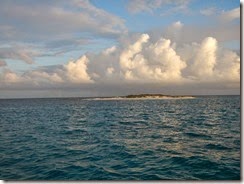
Sandy "bumps" in the road
We set sail early one morning in tandem with a lovely Puerto Rican cruising couple who had been to Islas de Las Aves many times. Their vessel, a catamaran called CAMPECHANO, is aptly named as they said it translates loosely to “Nice Guy.”  Captain Ronnie is one of the nicest guys you’d want to meet. The fact that he also has extensive sailing experience and represented the USA in the Summer of ‘84 in Olympic Sailing left us fully expecting that Exit Strategy would be eating COMPECHANO’S dust, so to speak. Once underway, they rounded the southern tip of Bonaire well before us and by the time we cleared that point their cat seemed to have disappeared. We thought they may have dropped their sails to motor as the wind that day was ESE. Then we noticed a white sail way far north of us.  We didn’t think that could be CAMPECHANO because our intended course to Las Aves was pretty close to due east.  We monitored VHS Channel 16 and finally were hailed by them a few hours later. It was then that we learned that Captain Ronnie doesn’t race anymore.  Now he sails to FISH.  It was his vessel that we spotted far to the north- a course he’d taken to follow the birds who would lead CAMPECHANO to fish.  And FISH they did!  By radio, he reported that they had hooked and landed “a monster of a fish” and were now heading toward our set destination.
Not your usual fishing boat, is it?
Islas de Las Aves are only scantly inhabited by mainly fisherman who live on one of the southernmost cays. The islands resemble small sand piles situated among the reefs. There are no trees, but the sand does support the usual grasses and beach vines. Las Aves is Spanish for the birds. I think they should be named Las Aves de NOCHES because they only seemed to chirp (no- make that squawk) at night. These cays lie in two clusters designated as Sotovento (meaning Leeward) and Barlovento (Windward). We anchored at Lighthouse Island and went ashore to sightsee.  It took only about 20 minutes to walk the entire circumference of this cay, but by the time we were nearly finished we encountered two uniformed men walking toward us. They explained in English (Thank God) that they, as Venezuelan Guardia Costa needed to board our boat to check us in.  There are no Customs or Immigration Offices in Las Aves, so as a courtesy the coast guard takes down your information and then allows you to “rest and cruise”* the waters of Las Aves for three days before you should continue on to Islas de Los Roques where there are C and I offices. The Guardia Costa were young and quite polite, saying we could contact them by radio if we needed anything.
DSCN2678
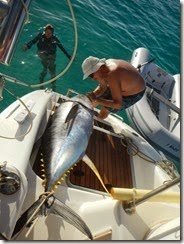
Ronnie's wife Babbie is in the water while Robbie- his twin bro- cuts up the monster. 
COMPECHANO arrived a short while later and was greeted by the Guardia Costa like old friends.  When the officers left, Ronnie called us over to get some fresh yellow fin tuna. It was a MONSTER of a fish and we took as much as we could fit in our freezer and fridge. (To date, we still have 2 mammoth-sized steaks left.) Then they treated us to a wonderful tuna dinner complete with a flan dessert made by Ronnie’s wife Babbie.

The following day the crew of COMPECHANO lead a lobstering expedition to a nearby reef with good results. The men donned their scuba gear and I mainly helped as a spotter and a bagger for Dan.
4977 (Medium)[1]
We found quite a few hiding under a huge stand of mustard-colored elkhorn coral.
Early on our third day in Las Aves, we said a sad good-bye to our Puerto Rican friends who began their passage north to their home port of Salinas, PR. Then Exit Strategy motored another seventeen nautical miless east and anchored behind a reef in Barlovento to “rest” another night before continuing on to Isla de Los Roques.


*By law all persons and vessels MUST clear Customs and Immigration upon entering/exiting a foreign country.  However, it is accepted practice that a captain may stop to rest or make a repair without officially clearing in, although one cannot go ashore.

Tuesday, November 11, 2014

DIVER DAN

DSCF6729
Can you spy the teensy weensy shrimp?
Ages ago when vacationing in the BVI with our best friends, we took an introductory scuba course that allowed us to dive with a dive master in water 30 feet or less.  I was not comfortable clearing the pressure from my ears due to having a history of ear infections and was content to forgo the diving experience. That was when we were in our mid-thirties and still young and beautiful.

DSCF6653
The reefy Salt Pier
In our early fifties, those same best friends invited us to take the full complement of scuba lessons with them to get our individual PADI licenses. Once again, I wasn’t interested because of my ear fears, but eagerly encouraged Dan. However, he didn’t want to unless I partnered with him, so our friends got certified without us.
DSCF6681
An octopus nestled into the coral
During these last four years of cruising, countless acquaintances have expressed what a pity it was that we weren’t divers because we were missing the exotic creatures of the deep Caribbean reef. (Well that, and being able to clean the bottom of the boat with greater ease!)
DSCF6730
Eww! A spotted eel on the left; dinner (grouper) on the right.
Finally, though, being in Bonaire- THE dive capital of the world- did it for Captain Dan. There are NO shortages of dive partners when in Bonaire, and it took Dan only about two months to decide that YES, he’d like to get his PADI certification. So he signed up, spent hours slathered in sunblock studying the textbook on deck, took the required written and in-water exams, and DID IT!!

DSCN2607
Dan positions himself to take the Mike Nelson plunge.
DSCF6708      
As soon as he got certified, he had offers to go diving with two to four other cruisers daily.  Many times I tagged along and snorkeled above them to watch from the surface as they meandered along the reefy bottom. I remain quite happy with being just a snorkeler, although I have been practicing swimming deeper and clearing my ears with limited success.
DSCF6707
Rose, the happy voyeur

Thursday, October 30, 2014

“C” is for CURACAO

DSCN2439
Dutch buildings are a bouquet of COLOR, especially here in Willemstad, the capital.
For a change of pace and scenery this year, we set sail for the island of Curacao to wait out the 2014 Hurricane Season.  Prior to putting it on our float plan, we had the impression that Curacao was a summer haven for a younger set of cruisers.  We were pleasantly surprised to learn that there were plenty of “old salts” in the main crowded anchorage of Spanish Waters, and it seemed that many of them came and never left.  It is a busy anchorage with dinghies, fishing boats, and day trip boats whizzing by. Although the water was clear, the bottom is dark and grassy and uninviting for swimming.

DSCN2540
Our view at anchor in Spanish Waters

Curacao is part of the Netherland Antilles and is the “C” of the ABC islands that are located just north of Venezuela.  It is now independent from Holland, but still very DUTCH, and perhaps that is why there is an overwhelming number of friendly Dutch cruisers here. There is also a growing population of Venezuelans who contribute to the economy by owning businesses, providing services, or shipping scads of fresh produce. Thankfully, almost everyone speaks English and the ATMs disperse Dutch guilders, as well as US dollars.
2014-06-19 12.26.07
This swing bridge opens when vessels enter Willemstad's Harbor.


Immigration for vessels was recently improved by allowing 120 days for visitors.  But clearance procedures, i.e. completing paperwork at both Customs and Immigration, is quite a hassle. Spanish Waters is about an hour bus ride away from the port of Willemstad where the offices are located. The offices are about a twenty minute walk apart and you must time your trip right to avoid their closed doors during their midday meal. Another downside to being in Curacao is that the authorities make it complicated for boats to move about to other anchorages. Each time you want to move, the Captain is required to secure an anchoring permit for the new location which may not be granted if too many other vessels have permits to go there. So Exit Strategy stayed put anchored in Spanish Waters. 


DSCN2471
Our engine was hauled out for routine maintenance.


While in Spanish Waters we elected to have a locally recommended mechanic work on a short maintenance list for our Volvo engine.  What we expected to take a few days, was finished bit by bit over ten weeks.  When we finally left the anchorage we motored to Willemstad to be pulled out so we could put on a few more coats of anti-fouling, replace the damper plate, and replace the oil seals on the sail drive. The mechanics there were able to get the job done easily after pulling our engine so they could access the damper plate.  We had a good experience at Curacao Marine.

DSCN1906
Burgers for 4th of July with Tony & Jane of sv Capisce.


Grocery shopping is a challenging endeavor here if there is no picture or English on the packaging to identify if the item is what you need to buy.  One can guess correctly at some cuts of meat, but unless you can read Dutch it is impossible to identify others.  Cheese- CHEESE! It seems that they mainly have gouda- no cheddar, and it is gouda light, gouda dark, gouda with wasabi, or with dill or maybe cumin, or with something red… Deli counters with freshly sliced meats are rare and most stores only package enough lunch meat for one sandwich! 

DSCN1938
Long-maned horsehead formation in the caves
Our frustrations with Curacao were luckily balanced by our upbeat experiences with cruiser friends we met there. We enjoyed many an afternoon playing (but never winning) Mexican Train Dominoes on one boat or another. We joined others for hikes to a couple of different beaches where we snorkeled and lounged. We wandered the quiet roads near Spanish Waters to explore the ruins of a fort and some salt ponds with friends who were in to geocaching.  Occasionally, we ventured into Willemstad by local bus to shop, have dinner, and attend an English mass. We also rented a car a few times to tour around the island during which we visited some caves and I ate stewed iguana for lunch. (It was at a restaurant and quite flavorful in a red gravy with the taste and texture being a cross between chicken and pork,only with a lot more bones.)

DSCN1945
My iguana lunch platter
I didn’t intend for this entry about Curacao to come off like a rant because our experience there DID have some redeeming qualities.  However, what it boils down to is that we enjoyed Curacao so much that we are planning an extended stay in BONAIRE for the Hurricane Season of 2015!

PS:  We took ARUBA, the “A”, off of our float plan because we had vacationed there by plane years ago and heard that now it is even more built up with no real appealing anchorages.

DSCN1919
"SEX Stones" as our friend Barb dubbed them...F---ing rocks.
37740002
Dan, me, Barb, & Jimmy in Aruba around 1987